THERE’S not much retiring military chaplain Deacon Graeme Ramsden hasn’t seen.
The senior police chaplain, husband, father of four, grandfather, and former tradesman veteran of the Vietnam War was so moved by his chaplaincy experiences in East Timor he’s made them public.
Letters From Timor is based on handwritten letters sent home to his wife of more than 40 years, Dianne.
The personal account allows a riveting, often amusing and incredibly detailed insight of life, death, survival – and above all else, faith in God.
Deacon Graeme, who celebrates his 66th birthday this year, ministers within Cleveland parish, on Brisbane’s bayside, and is a full-time police chaplain, said he put the book together as a type of “letting go”.
“I felt it necessary to share what was happening to me there with Dianne,” he said of his initial thoughts to put pen to paper.
“I had also made a compact with myself to watch and learn all I could of what happened, so that I could keep the people in my unit informed.
“Many of them were locked into particular places and routines and couldn’t move around to see what was going on.
“They needed to know that they were contributing to good work.
“When I returned home I read over my letters as part of letting go and felt that others might benefit from seeing what I had put down.”
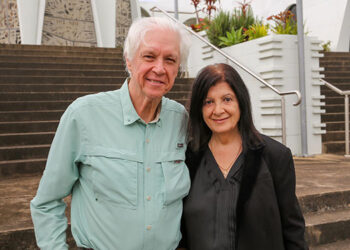
Asking Dianne of her thoughts of the very personal accounts moving into the public domain, she answered with confidence and gratitude.
“I do treasure my privacy and the privacy of our home,” she said.
“Graeme and I initially discussed the importance of my need for privacy in his work as a deacon … (and) we made the decision to never meet people’s pastoral needs in our home.
“Part of me therefore cringes a little at the publishing of the letters … (but) another part of me feels it is a wonderful thing that Graeme has had the opportunity to express a very tender part of his life that I feel was God given.”
Now, 11 years later, Dianne said she remembered “how good it was to receive his reassuring letters” – they were written daily if possible or “seven letters in two days” from notes taken.
“I remember his strong spirit of good will, I remember his patient tolerance,” she said.
“I remember his compassion and love for the people of Timor and always his enthusiasm for the good Australia and the Australian Army was doing there.”
Dianne hoped the book would celebrate “a heroic moment in Australian history thanks to General Peter Cosgrove and the men and women of the Australian Army”.
Letters from Timor features colourful maps and photographs, and Deacon Graeme begins by setting the scene before deployment from the Enoggera army barracks as chaplain to his unit “1 JSU” (Joint Support Unit).
“In August 1999 we had been training hard to Exercise Crocodile … (and that) included the Navy, the Air Force and the United States,” he said.
“We had also been working hard to get used to a whole new suite of communications equipment that had enhanced our capabilities considerably.
“We were aware that Australians might go to Timor … (but) most of us didn’t really believe we would go.”
Morale was his “special interest” and Deacon Graeme felt “ready” to be deployed.
He was responsible for religious services on Sundays and at any time, especially if there was a “casualty”.
Leaving Brisbane for Darwin on September 19, 1999, where they “spent the night on a cement floor”, Deacon Graeme recalled watching the then Australian Prime Minister John Howard declare “Operation Stablise” was taking effect with the deployment of INTERFET (International Force in East Timor).
“Spirits were high”, he also recalled, and it “could have been a deployment anywhere”.
“I think that is part of a soldier’s nature and training to believe that all will be well and that he or she is in no direct danger,” he said.
“Just as the Diggers who went to the First World War felt they were on a great adventure, so most of us seemed of a similar mind and disposition.”
By September 20 they had landed in Dili, East Timor, and the compassionate chaplain said he was “shocked” by its “primitive state”.
A letter dated September 26 (1999) is the first to appear in the book, affectionately addressed to “Didy”.
Countless follow, detailing accounts with locals, officers of all ranks, priests, the Salesian Sisters and even celebrities who visited to entertain the troops.
Deacon Graeme speaks highly of (the then) Anglican senior chaplain Len Eacott, an experienced army reserve officer before entering the priesthood, who ministered alongside him.
When the Right Reverend Eacott, as Anglican Bishop to the Australian Defence Force, wrote the foreword for Letters from Timor he described Deacon Graeme as someone with “a passion for the nurture of the precious men and women given to his pastoral care”.
“For the five months from September 1999 to February 2000, as his mentor, prayer partner, senior chaplain and mate, it was a great privilege to share with Graeme many of the circumstances and experiences that led to the concept for and writing of this manuscript,” Bishop Eacott wrote in 2008.
Deacon Graeme’s pastoral nature and approach also impacted others closer to home.
Maryborough parish priest Fr Paul Kelly first met the “no-nonsense” chaplain when studying together through the Brisbane College of Theology at Holy Spirit Provincial Seminary, Banyo.
“We shared a lot of classes,” Fr Kelly said.
“He was in the army and heading for diaconate in the military ordinariate … (and) I am grateful to him for proposing me for police chaplaincy as I have found it a deeply fulfilling and special ministry in addition to my parish work in Maryborough.”
After completing study in 1992 and upon celebrating his ordination as a military chaplain, Deacon Graeme said he was “the first married deacon chaplain in any army in the world”.
His military “roots” stretch back to his father who served as a recovery mechanic in Papua New Guinea and the Pacific Islands during the Second World War, and his grandfather who served in France during the First World War.
Deacon Graeme was born and educated in Kingaroy, north-west of Brisbane, and left school after Junior (Year 10) to work with an uncle “as a milkman”.
Dianne and Deacon Graeme’s eldest son Christopher has served in Afghanistan and now works in Laos.
Their second son Michael is a policeman and their only daughter Megan is a teacher in the Catholic system.
Patrick, the couple’s youngest, is a human resource manager, and Dianne has a Bachelor of Theology and a Masters in Pastoral Counselling.
Once his final day in Timor dawned – February 24, 2000 – Deacon Graeme said he felt they’d “done a good job” and “the people now have a chance”.
Still, he found he “had to grieve for the Timorese and say goodbye to them” and so fell to his knees.
“It was only a goodbye of a physical nature,” Deacon Graeme said.
“Spiritually I will never be able to say goodbye.
“… I have the sadness of what happened in Timor chiselled on my heart alongside the good things and the joy lived out by the Salesian Sisters and the Timorese people.”
Letters from Timor is available through Big Sky Publishing.