THE Catholic Church has produced much teaching about the world of work and industrial relations.
One great landmark was Rerum Novarum, an encyclical written by Pope Leo XIII in 1891.
In an era of much industrial unrest, this historic encyclical insisted on a living wage, the right to unionise and, in certain circumstances, even the right to strike.
At this time, we celebrate another great landmark in our Catholic teaching about work.
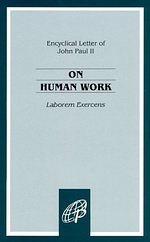
Twenty-five years ago, on September 14, 1981, Pope John Paul II released an encyclical called in Latin, Laborem Exercens, or in English, “On Human Work”.
Laborem Exercens marked the 90th anniversary of Rerum Novarum.
John Paul II was a phenomenologist. This school of philosophy pays close attention to various aspects of human experience so as to understand their meaning.
Laborem Exercens is therefore above all a phenomenology of human work.
The pope distinguishes between “work in the objective sense” and “work in the subjective sense”.
“Work in the objective sense” is what we accomplish in the external world by our work. For example, through our work we cook a meal, or build a house, or write a report.
On the other hand, “work in the subjective sense” is how we are changed by our work. Through our work, we grow and develop. We become more skilful, more industrious, more fulfilled.
There is much to reflect on here. The pope is directing us to that good feeling we experience at the end of a busy day.
He reminds us how good we feel when we’ve learnt a new skill.
He leads me to reflect that even when my father was elderly, he still liked to help out by mowing the lawn on the ride-on mower.
But this next point is important. Pope John Paul II insists that all considerations about work should focus predominantly not on “work in the objective sense” but on “work in the subjective sense”.
In other words, when we make decisions about work, we should not focus exclusively on the job that needs to be done.
Instead, we must focus above all on the worker, and how he or she will be changed and grow through their work.
“In the final analysis,” the pope insists, “it is always the human person, the worker, who is the purpose of work.”
This is a revolutionary insight, and some critics of the pope protest that it is just too idealistic.
Even so, I am convinced that John Paul II is correct.
When there are chores to do, really successful families ensure that everyone gets to do their bit, each according to their ability.
In the same way, really successful businesses don’t just focus on the job. Instead, they are just as focused on their workers, and on how this work will develop their workers’ skills and abilities.
And they know that team building is every bit as important as just getting the job done.
There was in the 20th century a great conflict between capitalism and communism.
Pope John Paul II critiques both systems for being too focused only on production, and too little focused on the worker and the dignity of work.
The pope calls this one-sided focus solely on production “economism”. He notes that it is closely connected with materialism.
From this perspective, the pope calls us to rediscover the rights of workers. He identifies three.
The first is the right to work, the right to employment. Given that we grow and develop through our work, we are therefore greatly harmed if we are not able to work.
The pope includes here a comment about disabled people, and their right too to work and contribute.
The second workers’ right is to just working conditions. These include a just wage and fair conditions of work.
A just wage is a family wage. It must provide for the worker and his or her family. It must “suffice for establishing and properly maintaining a family and for providing security for its future”.
Fair conditions of work include safe working conditions, time for leisure including at least a day off each week and annual holidays, and social security for injury and old age.
The third workers’ right is the right to unionise. The pope insists that “organisations of this type are an indispensable element of social life, especially in modern industrialised societies”.
Pope John Paul notes that going on strike is an “extreme means”.
However, he insists that “workers should be assured the right to strike, without being subjected to personal penal sanctions for taking part in a strike”.
Laborem Exercens is part of the living tradition of Catholic social teaching.
Thus, on November 25, 2005, the Catholic bishops of Australia drew on this tradition to call for changes in the Federal Government’s WorkChoices legislation.
They were particularly concerned with the impact of this bill on the poor and vulnerable, and on families.
Quoting Laborem Exercens, they identified four concerns.
Firstly, the bishops cannot see that the WorkChoices legislation gives sufficient emphasis to the family wage or “to the objective of fairness in the setting of wages”.
Secondly, they are concerned that many employees, especially the most vulnerable, may be forced to bargain away some of their entitlements, such as overtime rates, penalty rates and rest breaks.
Thirdly, the Australian bishops believe that the changes to the unfair dismissal laws will lessen job security.
Finally, the bishops are concerned that through this legislation the role of unions representing their members and other workers will be weakened.
“It would be wrong for the Parliament to enact laws that impede or frustrate unions in carrying out their lawful representative activities,” they say.
In 1891, Pope Leo XIII spoke about work in Rerum Novarum. Twenty-five years ago, John Paul spoke again in Laborem Exercens. Our Australian bishops have also spoken.
Because of the Catholic Church’s concern for social justice, it will continue to raise its voice on issues of work and industrial relations.
Fr Kevin McGovern lectures in Catholic social teaching at St Paul’s Theological College, Brisbane.